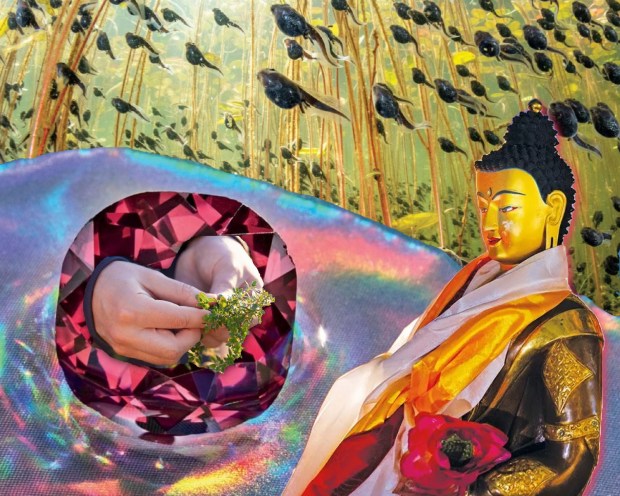
Offerings: A digital collage by Jaime Dunkle, 2025.
Greetings Lotus Budo readers! Jaime here, and I’d like to announce that I am facilitating an ongoing meditation practice (usually) every other Saturday morning. Details below. I will be sharing blog posts about what techniques we practice in each session. Also, because there are often interruptions to the calendar, I have created a separate Google calendar to help folks keep track of when these community meditation sessions are open.
Session Details
Every other Saturday, 10 a.m. to 10:45 a.m. at NOLA Aikido in Mid City.
Please check the calendar because dojo seminars and holidays will take precedence.
This biweekly shared practice is rooted in Shingon Buddhism, which the founder of aikido, O Sensei, is said to have practiced in his youth. Jaime Dunkle will share what she’s learned from this tradition at temples in the Pacific Northwest. Practice will include a mix of visualization and vocalization meditation methods. We will use apps like Calm, Plum Village, Insight, or Sattva for guided meditations. We will also sometimes sit with the bell. Only a short portion of this shared practice is silent sitting meditation. Bring a foldable blanket, your favorite cushion, or use one at the dojo. And please feel free to offer feedback and your favorite mediation methods: this is meant to be a shared practice space and not an instructional class. Quiet late entry is OK. FREE for dojo members and open for FREE to the community.
All community members must follow dojo rules on consent, respect, kindness, and personal hygiene so as to contribute to cultivating a safe and healthy practice space for all.
Cultivating harmony under authoritarian pressures through satyagraha, musubi, irimi nage, tantric confrontation, and beginning anew.
“The purpose of Aikido training is not to create aggressive fighters but to refine wisdom and self-control.” – Mitsugi Saotome Shihan, The Principles of Aikido
“If we are obsessed with desire, we may very well create the opposite effect.” – Taisen Deshimaru, Mushotoku Mind: The Heart of the Heart Sutra
Achieving a sense of harmony in daily life has felt near impossible as our global and national societies fall deeper into polarized conflict. I’ve been asking myself: How can I stay true to my humanitarian values while protecting civil rights and pushing against oppressive forces? I want to resist authoritarian pressures, and I want to keep my moral integrity intact. Is it possible? I believe that cultivating harmony under authoritarian pressures – and creating a beloved community – is possible if one practices a series of techniques:
Satyagraha (nonviolence)
Musubi (harmonious action)
Irimi nage (the courage to enter conflict)
Tantric confrontation (participatory forgiveness)
Beginning anew (restoring communication and relationships)
In this article, I unpack my interpretation of these nourishing methods. I hope readers find something that resonates.
Satyagraha and Civil Rights Activism
When one thinks of resistance, it conjures media-pushed imagery of overdressed riot cops, dumpster fires, and brutal attacks. But let us remember that practicing peace is also a form of resistance. After all, Martin Luther King, Jr. was able to practice peace as resistance through nonviolent direct action. Dr. King was inspired by Mahatma Gandhi and practiced satyagraha: “Spiritual rather than physical force, in which adherence to truth is central; non-violent resistance.”1
Dr. King describes the efficacy of satyagraha in his 1957 speech, “Birth of A New Nation,” about the Republic of Ghana gaining independence from British imperialism and colonial rule through consistent nonviolent protests and activism on March 6 that same year:
The aftermath of nonviolence is the creation of the beloved community. The aftermath of nonviolence is redemption. The aftermath of nonviolence is reconciliation. The aftermath of violence is emptiness and bitterness. Let us fight passionately and unrelentingly for the goals of justice and peace. But let’s be sure that our hands are clean in this struggle. Let us never fight with falsehood and violence and hate and malice, but always fight with love, so that when the day comes that the walls of segregation have completely crumbled in Montgomery, that we will be able to live with people as their brothers and sisters.2
Practicing a version of satyagraha today may look like peaceful protesting; using the socratic method (i.e., asking questions with the intention of seeking clarity) to call in those acting with discord; or merely learning your own truths in terms of moral obligation to become more aligned with them when you think, speak, and act.
Musubi: Blending, Becoming, and Harmonizing with Others
Musubi is a fundamental principle of Aikido practice. In the dojo, at its most basic, musubi is when we blend our energy, actions, and mental state with the energy, actions, and mental state of our partner. It has been translated into English as meaning unity or harmonious interaction.
During the pandemic, one of the main teachers from our lineage at the NOLA Aikido dojo, Endo Seishiro Shihan, who is based at the Aikikai Hombu Dojo in Japan, wrote an open letter to students that mentioned musubi in a heartfelt allegory:
…I have been training ‘Ki-musubi Aiki’ so that I can develop the ability to live and let live every moment with the partner (meaning the whole universe).
You are one and only, I too am one and only, and neither you nor I can be without the other.
All is connected. There has never been a time like now where we feel the connection of human beings, the closeness of the universe…
So if we combine all of these definitions, musubi is not only an Aikido principle or the act of harmonious blending: it is the ability to tap into universal interconnectedness, or what Thiền3 Buddhist monk Thich Nhat Hahn called “interbeing.” Therefore, musubi is not a passive state of absorption, it is an active state of mind-body-sprit communication and perpetual union. Harnessing this constant-becoming unified flow state of musubi is foundational in practicing peace in community. And merely being curious about it will work well, too.
The Esoteric Message of Peace in Irimi Nage
Practicing irimi (entering) nage (throw)demonstrates one of the clearest paths to peace on the Aikido mats. The first part of this basic technique allows for the uke (attacker) and nage (peace maker) to eventually face the same direction to see the same world ahead. In my lineage, the lesson runs deeper: not only do the uke and nage see the same thing, they share the same reality and are brought into the mindset of expanding their perceptions to include a mutuality that was originally unknown until they stood parallel. This is because they started by facing each other, and as nage enters, going behind uke to challenge their balance, they become side-by-side.
A secondary lesson here is that it takes the courage of nage to enter the confrontation initiated by uke for this deeper understanding of perspective to happen. Therefore, without the courage to enter a volatile situation, peace and reconciliation may not be possible.
It’s important to note that the nonaggressive approach to irimi nage at NOLA Aikido and at Vanadis Aikido in Stockholm4 stands out against the most common demonstrations online. We do not grab the head of our attacker, for instance, and I think that’s because doing so contradicts the Aikido aspiration to maintain harmony.
Tantric Confrontation Instead of Conflict Perpetuation
This concept of bravery leading to resolution can be taken a step further with the practice of tantric confrontation: the act of approaching someone who has wronged you and inviting them to be vulnerable and actively participate in the forgiveness process. This is the opposite of allowing a conflict to exist endlessly.
Around the time I experimented with this practice, my estranged and homeless father had died of emphysema-related heart failure. Needless to say, things were left unsaid and unresolved. I feared my intimate relationships would be doomed forever because there was no way for us to reconcile. I wondered if I could somehow transform my grief and frustration into reconciliation, and thus began my journey.
Fortunately, I had also learned about trauma-informed care and adverse childhood experiences at this time, which inspired me to interview my father’s siblings. I found out he had endured a lot of childhood trauma that led to his life of substance abuse and crime. I even had psychiatric and legal evidence of it, including pages of his DUI report on that old perforated accordion paper for dox matrix printers.
It took a lot of effort and investigation, but I finally was able to lay to rest the hungry ghost my father left behind. This was one of the most profound moments in my entire life of stubbornly seeking peace, and I hold onto it as a hopeful reminder for when peace feels impossible.
Beginning Anew
When someone is still alive, the ancient practice of beginning anew can restore and strengthen social bonds. These practices are outlined in Beginning Anew: Four Steps to Restoring Communication by Sister Chân Không. Practitioners from the time of the Buddha practiced a version of beginning anew at the onset of every full moon and new moon, according to Thich Nhat Hahn. The four steps are simple but not easy:
Flower Watering: Share what you sincerely appreciate about the other person(s). This helps stop the potential of taking people for granted.
Say Your Regrets: State what you know you have said harshly or done that was unkind. This helps build a habit of self-reflection, expressing remorse, and thus creates an opportunity for deeper understanding.
Express Your Pain: Say what others did to hurt you. Name it but with loving speech. This helps teach people, and ourselves, our triggers and how to be kinder to us.
Hugging Meditation: This is something added in modern times to unite East and West. Embrace with genuine care, if there is mutual consent to do so.
Participation in these steps helps cultivate skillfulness through compassionate listening and loving speech. I wish everyone in the entire world would study and practice these teachings. I truly believe if we regularly followed these steps in everyday life, we’d be a happier society because we’d be more respectful, intuitive, and kind-hearted toward one another.
Practicing peace instead of fighting each other is the ultimate form of resistance. As cultural critic Noam Chomsky points out in The Prosperous Few And the Restless Many, namely in the chapter “Divide and Conquer,” separating groups and inflaming pre-existing rivalries instead of resolving them is how imperialist governments strategically manipulate the masses. But let us remember that it is through practicing self-control that we can prevent behaving foolishly toward one another and being manipulated by power structures.
Practicing satyagraha, musubi, irimi nage, tantric confrontation, and beginning anew are all ways to challenge the polarization foisted upon us by the authoritarian takeover in the United States. I truly hope readers find something worthwhile from these peaceful approaches to resistance. I encourage folks to integrate what they glean from these peace-giving strategies into their everyday lives so that we may all co-exist peacefully, respectfully, and with humble dignity.
The dojo of my main teacher’s teachers in Vanadis Aikido in Stockholm, Sweden. My main Aikido sensei is Brian Levy Sensei. Two of his teachers (Shihan) are Jan Nevelius Shihan and Jorma Lyly Shihan. I have had the fortune of practicing with them both, and they are very powerful but soft. Our style reminds me of my cat showing his strength and choosing not to use it. ↩︎
The cultivation of kan vision is a regular practice in aikido. Kan vision is when you expand your sight beyond what is right in front of you (ken vision). The practice builds a hyper-awareness of your periphery, but it doesn’t stop there.
Studying kan vision as a novice has revealed to me that overall awareness, and radical compassion, can be increased the more one magnifies visual capability.
When kan vision was introduced to me as a concept in the NOLA Aikido dojo, the class was instructed to widen our vision to perceive not only the shomen (front of the dojo) ahead, but also the ceiling above, the mats below, and the walls on either side of us. Bonus points if you can feel what is behind you.
This aspect of kan vision practice reminds me of when I studied juvenile corrections in junior college. We did exercises that imitated police officer training, which tested peripheral vision in the context of quickly analyzing crime scenes and writing police reports based on the memory of these scenes. I discovered that focusing on peripheral vision enables the recall of details beyond an average scope. It also allowed me to immediately sense potential risks of harm. However, this is merely the external practice of kan vision. Beyond the surface, there’s a deeper life-altering sensory development that occurs.
With the unfettered freshness of a beginner’s mind — known as shoshin in Zen practice — I’ve allowed myself to extend kan’s amplification of view beyond stretching literal sight. Kan vision is also a way to enhance perspective.
In the book Vibration and Connection: The Aikido That I Pursue, Endo Seishiro Shihan says, “Think, execute, see, and feel broadly during aikido keiko [discipline, i.e. regular practice].” Likewise, in the aikido dojo, we are instructed to practice softly, which also stems from the guidance of Endo Shihan. This makes me wonder if, as an internal practice, kan awakens the ability to comprehend and experience the Buddhist concept of sunyata, or interconnectedness, firsthand. If so, then kan’s sense of interrelatedness can bring both aikido and Buddhism into everyday life.
In the Spirit of Aikido by Ueshiba Kisshōmaru Dōshu, he talks about “the working of kan” as being an “intuitive quality” only achieved after years of training, in the context of sword making. Apparently a German scientist was unable to replicate the Japanese formula for crafting swords because there was a special ingredient missing, which Ueshiba Doshu called kan. He likens kan to a mix of single-minded concentration and spiritual wisdom only emergent after diligent practice. This references the internal process of kan insight.
Since practicing kan vision, I have developed not only a sensitivity to seeing widely but also a sensitivity to my surroundings. A sensitivity that reaches further than physical spaces. Subtle nuances in people’s moods or the vibe in a room appear even more obvious to me now.
I have used this newfound kan acumen as a way to de-escalate conflict, avoid harmful scenarios, and navigate emotionally charged incidents. Kan has helped me intuitively move through difficult circumstances, and without stoking present dangers.
When practicing kan, it becomes easier to read situations and people. This means kan is also a way to become more thoughtful toward others. Elongating circumferential view via kan practice eventually transforms to the practice of harmonizing with other people and your environment. Partly because it grows your sense of empathy. Therefore, kan is one way to practice the Buddhist concept of upaya-kausalya or skillful means.
Kan opens the eyes and mind, broadens spiritual practice, and increases capacity for empathy because kan is foundational in the development of harmony and compassion.



 Lotus Budo