Welcome! Every few weeks, this blog will be updated to recap some of the meditation methods we are exploring at NOLA Aikido dojo. Your author, Jaime Dunkle, is the primary facilitator of this practice time, bringing meditation techniques she has learned directly from Shingon Buddhist monastics who teach meditation to laypeople. However, Jaime is not a teacher. Her intention is to share practices to build a learning community. Please also know she is open to any kind and respectful feedback or new connected ideas.
Here in New Orleans, we are still easing into spring but also anticipating the inevitable summer heat. This means that we are experiencing a lot of rain storms followed by hot and humid days. Such a swampy mix can cause a bit of a sluggish feeling. This Saturday, May 30 started off muggy in the morning, but the slump that follows faded as soon as I entered the NOLA Aikido dojo. To me, this generative energy is the magic that comes with having access to a dedicated practice space, for which I am grateful.
This week during the Dynamic Meditation session, we focused on breathing, syncing the body and mind through the breath, some health qigong, ah vocalization, and quickly introduced moon disc meditation.
Stretching & Forming a Circle
After attendees arrived, we collectively decided to start with our favorite stretches to help us ease into our bodies so we would be able to sit comfortably for the rest of the practice session. After engaging in our own preferred stretching routines, we sat together on cushions in a circle. The circle is important here to facilitate a seminar style of practice, except for there is not an expert present—just a facilitator. Anyone at any time is welcome to share a meditation practice they enjoy, if they so choose. This is ultimately a democratic practice space that begins and ends with our joined efforts.
Sitting
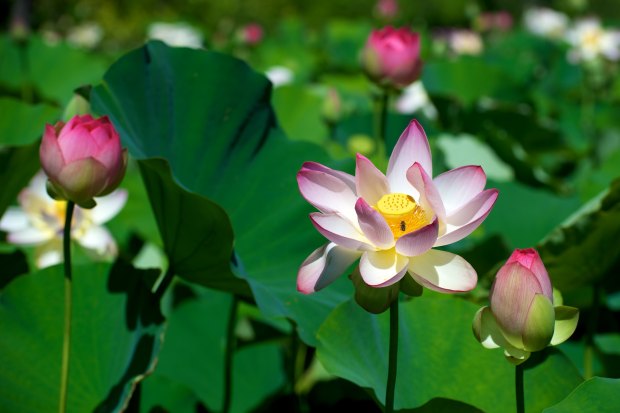
Sitting, in the way I have been taught, involves several points of focus—once you are seated in a full, half, or quarter lotus position:
- The hips need to be elevated using a cushion, blanket, towel, yoga block, or a stack of books.
- The knees are in the best position when making contact with the floor. If there is space between knees and the floor, it may be more beneficial to add more height to your seat.
- The spine needs to be straight—if you sway back and forth and side to side, it may be easier to find an internal balance that helps keep the spine in the most optimal place for meditation.
- You want to feel rooted in the ground but not stiff in your upper body: the seated sway also helps loosen tensions.
- Roll your shoulders back and lower them so they are not tightly reaching for your ears.
- Tuck your chin in toward your chest ever so slightly and imagine a string pulling your skull and spine up as if your bones are connected to the sky.
- Gently settle your tongue on your soft palate so that it rests behind your upper front teeth.
- Gaze down the center of your nose to a spot a few feet in front of you, keeping your eyes half closed. The way it was explained to me by my teacher is that this helps prevent the movies of the mind from playing on the screen of the eyelids, which can lead to distractions.
- Place hands in the dhyana mudra, which is commonly used in meditation practice. When using Shingon-Shu form, your left hand is on the bottom, and your right hand rests on top of it, then the thumbs touch forming a triangle. This triangle is said to represent the triple jewel of the Buddha, dharma (teaching), and sangha (practice community).
- This structure may be modified if someone needs to instead sit in a chair. It is recommended they sit at the edge of the chair with feet flat on the ground so that the spine is in the most optimal placement.
Breathing
From what I have gathered, there are numerous ways to breathe, especially in regard to meditation practices. This week, we focused on a particular type of breathing that research has shown helps calm the nervous system: full intentional belly breaths. First, we all took several full belly breaths, inhaling through the nose and exhaling through the mouth.
After a few minutes of belly breathing, we moved to practicing health qigong that helps monitor your lung capacity, reduce stress, and strengthen your immune system. I learned this method during COVID-19 times, when Kosho Finch Sensei from the Henjyoji Shingon Buddhist Temple shared it with his students. The original video is posted for your reference at the end of this section.
Before you begin, if you are in a group, it is important to know that everyone has different lung capacity, and so people may breathe at different paces. This is okay. Also, if you cannot hold comfortably for the recommended duration, do not force yourself. Instead, make a note of your lung capacity and take good care of yourself.
Here’s how to engage in this lung check health qigong technique:
- In a seated position, bring your hands in front of your torso in a comfortable angle and find your pulse on the wrist with the first two fingers of your opposite hand.
- Breathe in your usual manner a few times to make sure you can feel your heartbeat.
- Now, take full belly breaths, inhaling through your nose, reaching the top of your lungs.
- Hold your breath at the top of your lungs for 20 heartbeat counts.
- Repeat for a few minutes.
Synchronizing the Body and Mind
This next method is something Finch Sensei taught recently during a dharma talk I attended online. The idea, as I understand it, is to do this practice before formal meditation practice to help connect the body and mind so that they are more synchronized during meditation.
While in a seated position, take turns lifting one of your hands as you breathe. I prefer to start with the left for a few breaths and then move to the right. It can go something like this:
- As you inhale through your nose, raise your left hand gently to follow the extent of your breath.
- When you reach the top of your breath, pause your hand movement.
- As you exhale through your mouth, lower your hand to match the pace of your breath.
- After a few rounds, repeat these actions on the right side.
Ah Vocalization
The way Finch Sensei, and also Taijo Imanaka Sensei (from Seattle Koyasan Shingon Buddhist Temple), have explained the Ah syllable to the sangha is that it is from the Siddham language, which predates Sanskrit. According to their separate teachings on the dharma from their respective temples, in the way I understand them, the reason Siddham is used in Shingon instead of Sanskrit is to distinguish the quotidian from concentrated practice. It’s similar to how we wear an aikidogi on the mats and not street clothes at NOLA Aikido so as to separate our concentrated practice from everyday life. Because Sanskrit is still commonly used as a written language, Siddham helps with practicing away from daily life. That’s not to say that either training doesn’t get integrated into one’s life. Aikido nor meditation is meant to be an isolated or escape-from-reality practice, from what I have learned.
A practice such as the Ah vocalization is especially useful for integrating into daily life because it can help reduce stress, calm the nervous system, and clear the mind. For me, it has even dispelled intense pain.
It’s important to know that at home or the temple, I/we first use traditional prostrations and mantras before starting the ah vocalization practice. We do not add the mantras at the Aikido dojo and instead engage in a truncated version of the practice. Before I share the steps of this edited version of chanting Ah, it’s important to know that not everyone has to chant at the same time. Again, we all have different lung capacities, so it’s okay to chat out of sync. The abridged version of the Ah vocalization we use at the dojo is as follows:
- As you inhale through the nose, imagine a mist or fog entering your lungs that helps heal your anxieties, worries, fears, frustrations, pains, or whatever needs healing.
- As you exhale through the mouth, release whatever it is that you need to let go.
- After you do this for a few breaths, begin vocalizing the sound “aaahhhh” as you release what needs to be let go, imagining that whatever is expelled drifts far away. Sustain the “ah” sound through your entire exhale.
- After several minutes of this practice, the facilitator rings the bell and everyone sits with the residual silent Ah that resonates in the space.
Moon Disc Meditation
We didn’t have much time left to practice the moon disc meditation, but we did get a brief introduction that will segue nicely into a more in-depth practice scheduled for a later time.
What we did get a chance to do was consider the full moon as representative of our universal great compassion for all living beings. For a few moments, we got acquainted with this idea and focused on the moon disc image in front of us. We brought its spherical fullness to our center, took a few breaths, and offered the moon back to the image.
At the end of the session, we thanked each other. After all, showing gratitude is foundational for our practice.
Future Topics
In the next few posts, I will share more information about past sessions. We have experimented with vocalizing popcorn thoughts of gratitude about the rain and the concept of mother. We have also visited how there are many forms of meditation (not just silent sitting), which generated a concentrated discussion on other ways to practice. We’ve engaged in lake and mountain meditations. We sometimes incorporate standing and walking meditation. We also access the Plum Village and Calm apps for their guided meditations to help us with different practices focused on thanking our body’s invisible functions, overall gratitude, loving kindness, and thanking the earth.
Thank you for reading, and we hope you can join us for this free, bi-weekly community practice session. For more information, please go to: https://lotusbudo.com/category/dynamic-meditation/
Links
Please use these links to discover more about Aikido and Shingon Buddhism:
- NOLA Aikido: https://nolaaikido.com
- Henjyoji Shingon Buddhist Temple: https//shingonpdx.com
- Seattle Koyasan Shingon Buddhist Temple: https://seattlekoyasan.com
- Foundation for Shingon Buddhism Dharma Talks: https://www.youtube.com/@foundationforshingonbuddhi3723/playlists

